11 min
What a Sauna and Cold Plunge Cost Across Africa in 2026
An honest continental price breakdown: what a sauna and cold plunge cost in eight African countries, what move…
Read more →A camp spa is an off-grid engineering problem with a hospitality brief attached. Get the engineering right and it becomes the most photographed thing on the property.
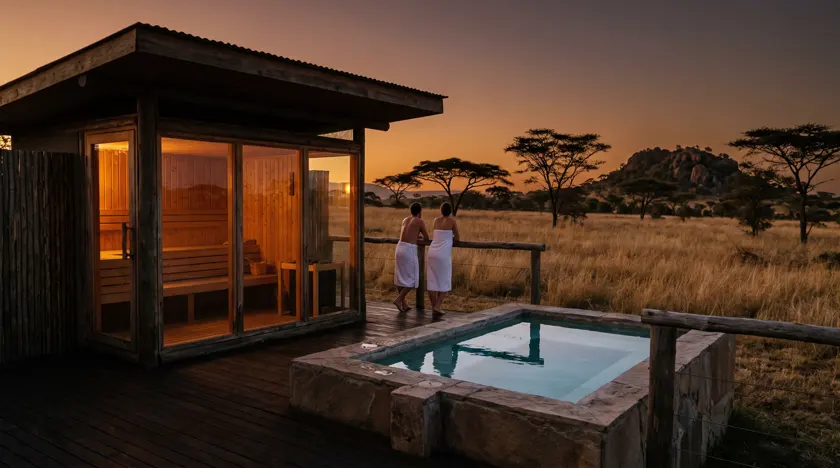
The demand at a safari camp is not spread across the day. It is concentrated into the ninety minutes between the afternoon game drive returning and dinner, and again briefly at dawn. Everything is sized on that window.
In practice this means more plunge positions than a guest count suggests and a heater that reaches temperature quickly rather than one that holds it economically all day. A cabin that takes an hour to get hot is useless when guests are back at five and eating at seven, so we insulate heavily and size the heater for the heat-up rather than the hold.
It also means the plunge should not be across the camp from the sauna. Guests move hot, cold, rest, repeat, and if that sequence requires walking past the dining tent in a towel, the sequence does not happen.
Most Tanzanian camps run solar with battery storage and a generator for backup. The heater and the chiller are the two largest loads on the property and they must never start simultaneously — a simultaneous start is what trips a generator or drains a battery bank in the middle of the guest peak.
We sequence them in the controls: the heater starts first, the chiller is inhibited during heat-up and picks up afterwards. Where there is meaningful solar we schedule the heater into the solar window and let the plunge coast on its lid through the evening.
We work from the camp's actual figures — inverter capacity, battery bank, generator rating, existing base load — not from assumptions, and we give the camp manager a load profile rather than a nameplate rating. Camps that have been burned by a previous installation ask for exactly this, and camps that have not should.
Camps truck or borehole their water, and a plunge tub is one of the larger discrete water demands anyone will propose adding. We size the tub against the water budget rather than the brief, and we design for long water life rather than frequent changes.
That means circulation, cartridge filtration and an ozone or UV stage as standard, plus a rinse shower at the entry point. A rinse point turns a weekly water change into a monthly one, which at a remote camp is several truck journeys a season.
The insulated lid is the cheapest component in the installation and the one with the largest operating effect. It reduces evaporation — which in dry-season heat is significant — and it holds temperature overnight so the chiller starts the day where it finished.
In the dry season, dust in the Serengeti and the southern parks will blanket a condenser coil within weeks. A blanketed coil cannot reject heat, so the compressor runs longer and hotter, the water never quite reaches temperature and the unit fails early. This is the single most common cause of chiller failure in the Tanzanian bush and it has nothing to do with the size of the machine.
The answer is a dust package: washable pre-filters on the intake, a sealed plant housing, the unit sited away from the approach track and prevailing dust, and a three-month service interval that is actually kept. We build the filter change into the camp team's routine so it happens between our visits.
The same dust affects everything else more slowly. Hinges, catches and seals are specified to be cleanable rather than sealed-for-life, because out here everything gets cleaned eventually.
Tanzania's camps are not one climate. A crater-rim property at around 2,300 metres has cold nights and thin air: the heater is corrected upward, floors are insulated as heavily as walls, pipework stays inside the insulated envelope, and the plunge often needs no chiller at all.
A southern-circuit camp in Nyerere is hot and low: the plunge is the hero product, it needs shade and a properly sized machine, and the sauna is the second act rather than the first.
A few camps operate in both, and those get both specifications explicitly quoted rather than an average of the two, which would be wrong in both places.
Where a camp is reached by light aircraft, the design constraint is not aesthetic or structural, it is the aircraft's door and weight limit. We establish that limit before the first drawing and build the whole installation in panels and components that fit it, carried by two people.
Discovering this at the airstrip is a well-known and expensive way to learn it. We have taken over projects where exactly that happened, and the recovery is always more costly than designing for it from the start.
Many camps close for part of the year. An installation left wet, full and unattended through a closed season degrades fast. We build in a written shutdown routine — drain, flush, cover, protect, isolate — and a matching start-up routine, and we walk the team through both.
It takes an afternoon and it is the difference between opening the season with a working spa and opening it with a repair bill.
Nobody is driving four hours for a filter change. We service the parks in scheduled blocks so several camps share the travel, we leave a spares kit with part numbers on the lid, and we train the camp maintenance team at handover to handle everything routine themselves.
The training is the part clients undervalue and the part that decides whether the installation is still working in year three. Camp teams turn over; a spa that was never properly explained to anyone becomes a spa that quietly stops being offered.
A plunge that is drained, a rinse shower and a sauna floor all produce grey water, and in a national park or conservation area that water cannot simply soak away wherever it lands. Authorities ask, and increasingly they ask in writing.
We design the route: a soakaway correctly sited and sized away from watercourses, or a collection and treatment arrangement where the camp already has one, with biodegradable cleaning chemistry specified from the start rather than substituted later. Chlorine-heavy treatment is the wrong answer in a park and ozone or UV is the right one, which conveniently is also better for the guests using the water.
This is one of the few parts of a camp project where getting it wrong is not just expensive but genuinely damaging, and it belongs in the drawings from day one.
A deck with a cabin, a plunge and a view is photographed by guests, appears in reviews, and gives a camp something to say that its neighbours cannot. It is also a genuine comfort after a long dusty drive, which is the honest reason it works.
Built properly it costs a predictable amount to run and needs four visits a year. Built badly it is a broken compressor in a shipping container and an apology at check-in.
Want this checked against your own room? Send us the dimensions and a photograph and we will come back with a drawing.
An honest continental price breakdown: what a sauna and cold plunge cost in eight African countries, what move…
Read more →
An honest breakdown of sauna and cold plunge prices in Tanzania: what fits inside 12 million TZS, what pushes …
Read more →
From Nairobi at 1,795 m to the Ngorongoro rim: why African highland saunas need a bigger heater, and why the s…
Read more →